



O youth, devote yourselves to seeking knowledge and leave aside everything else. Trials and tribulations spread quickly, and escaping them is difficult.
Leave alone those matters that do not concern you. The Prophet ﷺ said:
“Part of the excellence of a person’s Islam is leaving what does not concern him.”
Ibn Ḥajar رحمه الله said:
“Everything that distracts a servant from his Lord is a trial.”
Seek knowledge, and you will distinguish truth from falsehood. Seek knowledge, and you will recognize who is correct and who is mistaken.
Seek knowledge, and you will learn the fundamentals and principles. Whoever understands the fundamental principles will be given success to reaching the goals.
But whoever is deprived of them and remains ignorant of them will spend his life stumbling about in confusion.
Written by Shaykh Idrīs ibn Saʿd al-ʿUshaybī
Translated by Abu Anas Atif Hasan
Updated: Sep 1

Shaykh Fawzan on learning Arabic
The young and the old should strive to learn the Arabic language, for it is the key to understanding the Qur’an and the Sunnah. Through it, a person gains countless benefits.
The explanations of Salih al-Fawzan should serve as a strong encouragement for both the young and the old to set aside a portion of their day to learn Arabic—just as they dedicate time to other aspects of their religion.
Just as a person is consistent in performing voluntary acts of worship, they can also be consistent in studying Arabic—even if only a small amount each day.
Regardless of the level one reaches, it must be remembered that seeking Islamic knowledge is an act of worship.
Just as a person:
prays,
fasts,
gives charity,
enjoins good and forbids evil,
—all of these are acts of worship.
Likewise, learning the Arabic language—in order to understand the Qur’an, the Sunnah, and the speech of the scholars—is also an act of worship.
Learning Arabic consists of several essential parts:
reading
writing
comprehension of what is read and heard
and speaking
A person should reflect on where they stand in each of these areas, and what benefits they seek from the Arabic language.
The one who cannot read is deprived of reading directly from the Qur’an and earning the reward of its recitation.
The one who cannot understand what is heard when recited within prayers and out—is deprived of benefiting from reflecting upon its recitation at those times.
And the one who cannot understand spoken Arabic is unable to directly access the inheritors of the Prophets—the scholars and the knowledge preserved in books.
So, start and be consistent—even if it is little. Every step you take in Arabic is a step closer to your religion.
Abu Anas Atif Hasan
Updated: Sep 1
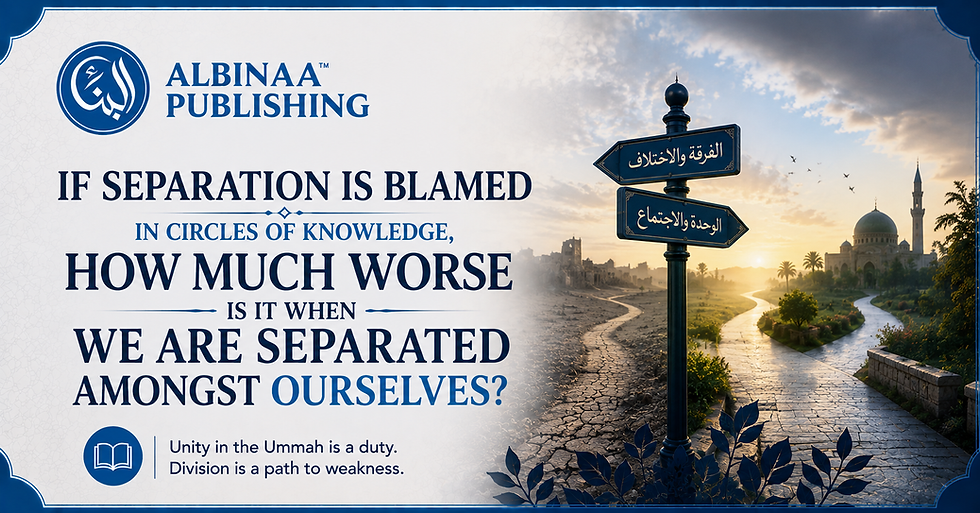
Prior to beginning a talk, Shaykh al-Albānī رحمه الله emphasized certain etiquettes related to gatherings of knowledge.
It is reported in the Musnad of Imām Aḥmad, in the ḥadīth of Abū Thaʿlabah al-Khushanī رضي الله تعالى عنه, that he said:
“When we used to travel with the Prophet ﷺ, we would spread out into the mountain paths and valleys. One day, he said to us: ‘Indeed, this spreading out of yours is from the actions of Shayṭān.’”
Shaykh al-Albānī explained that this did not occur during a gathering of knowledge. Rather, it occurred during a journey in the open desert. They would spread out, with each person choosing a spot—such as beneath a shaded tree, near a cool valley, and the like.
The Prophet ﷺ disapproved of this spreading out among them and said:
إِنَّمَا تَفَرُّقُكُمْ هَذَا مِنْ عَمَلِ الشَّيْطَانِ
Indeed, this spreading out of yours is from the actions of Shayṭān.
Abū Thaʿlabah رضي الله تعالى عنه said:
After that, whenever we stopped in a valley, we would gather together so closely that if we had sat on a single mat, it would have been sufficient for all of us.
They responded to Allah and to the Messenger when he called them to obedience. As a result, they no longer separated from one another at their stopping places, even though they were traveling. Instead, they would gather together.
What is the secret—or wisdom—behind the Prophet’s ﷺ concern for keeping the people together and not allowing them to separate in their lodgings, even in the open desert? What is the wisdom behind this?
Shaykh al-Albānī رحمه الله said:
I say: "Indeed, because what is apparent is a sign of what is inward. When Muslims become divided outwardly, that becomes a cause for them to become divided in their hearts.”
Source: Jāmiʿ Turāth al-Albānī, vol. 1, p. 220.
Translated by Abu Anas Atif Hasan